


How To Tell If Your Roof Has Hail Damage (What Does It Look Like?)


When you live in Colorado, you know hail storms are a dime a dozen. But most people who just sat through a recent hail storm find themselves standing on the driveway, looking up, and wondering the same thing: what does hail damage look like on a roof, exactly, and how can I tell if my roof has been impacted?
Sometimes the answer is staring right at you: chunks of broken tile in the flower beds, shingles in the yard, gutters hanging crooked. But the hail damage that ends up costing homeowners the most is rarely that obvious. It hides. A bruised shingle mat looks almost normal from twenty feet. A hairline crack in a tile doesn’t announce itself until the bedroom ceiling starts to stain six months later. By then, the bill is three or four times what it would’ve been if someone had gotten up there and looked for hail damage on your roof.
In our guide, we’ll cover what hail damage actually looks like across every common roof material, what you can check from the ground, how the insurance inspection process works, and what separates a roof that needs work from one that can wait.
Table Of Contents
- What Hail Damage Looks Like By Roof Type
- Signs Of Roof Hail Damage To Look For From The Ground
- How To Tell If Your Roof Has Hail Damage Or Is Just Aging
- What Insurance Adjusters Look For To Tell if Your Roof Has Hail Damage
- What To Look For In A Good Roof That’s Less Susceptible To Hail Damage
- How Hail Damage Quietly Shortens The Life Of Your Roof
- What Level Of Hail Damage Warrants Repair Or Roof Replacement?
- Should You Get A Roof Inspection To Assess Hail Damage?
What Hail Damage Looks Like By Roof Type
Hail damage will take on a different look based on the type of roof you have. The roof material matters a lot, and so does the age of the roof, the size of the hailstones, and which direction the wind was driving them. Here’s what to look for depending on what type of roof is over your head.
How To Tell If An Asphalt Or Composite Shingle Roof Has Hail Damage
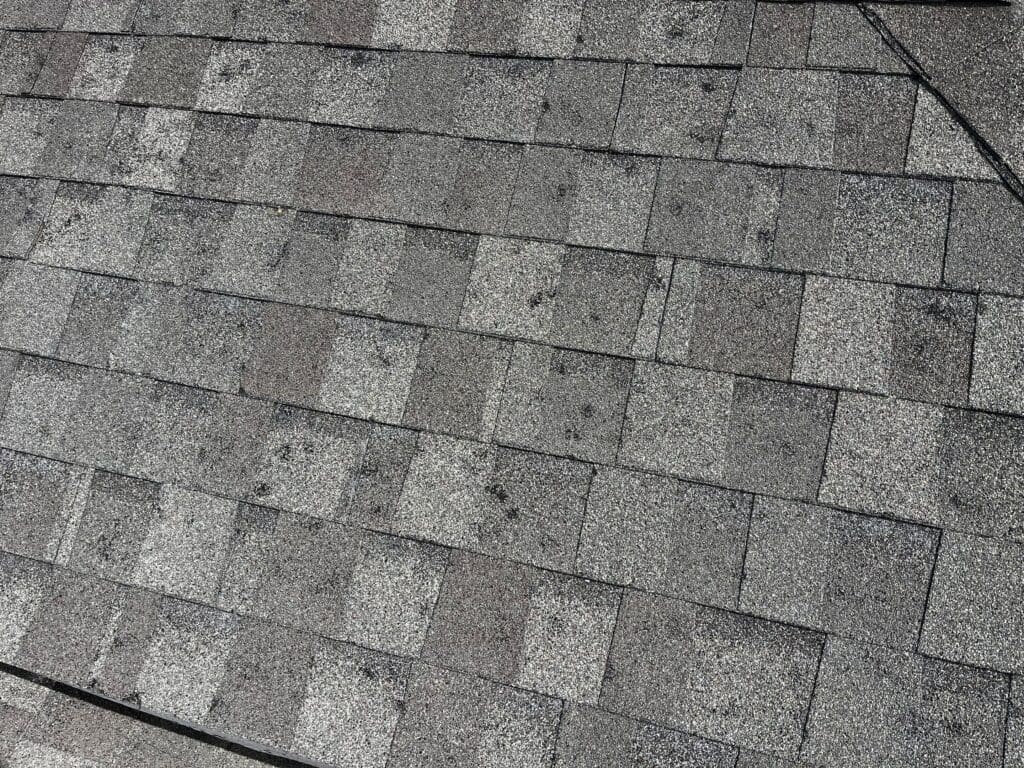
Asphalt shingles cover more residential roofs in the Denver metro than any other material, which is part of why hail damage claims in Colorado are so common. When a hailstone hits an asphalt shingle, the first thing it does is knock granules loose. Those granules aren’t decorative. They protect the asphalt mat underneath from UV breakdown. Lose enough of them, and a shingle that should last 25 years starts failing at 12.
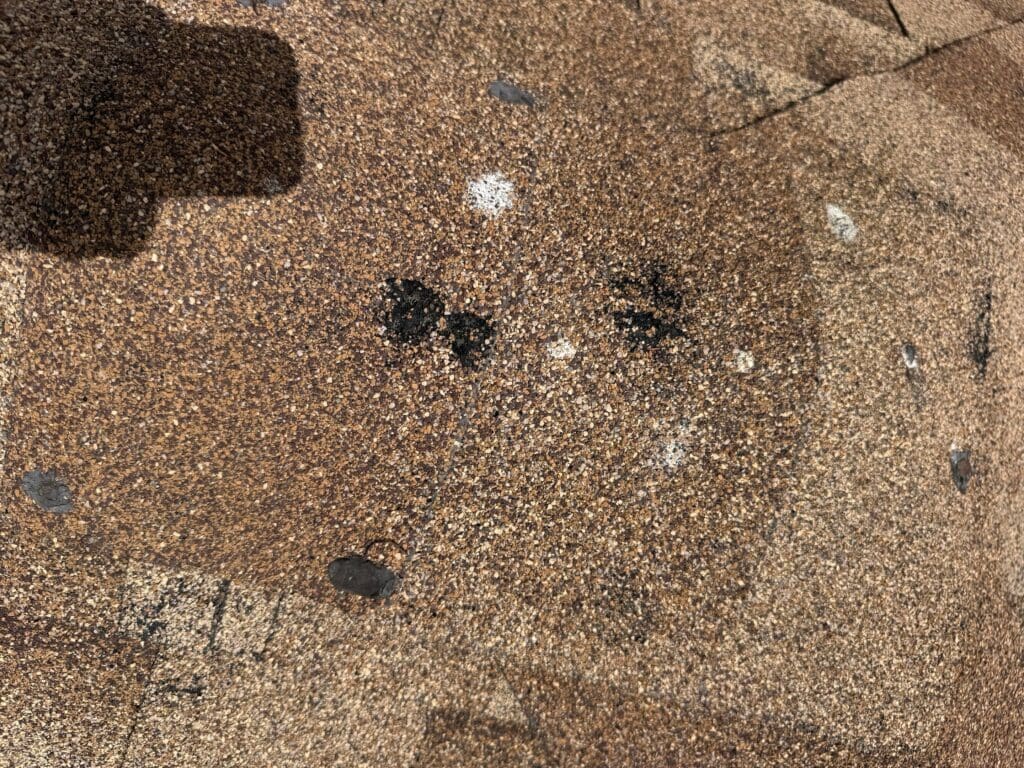
Hail damage to asphalt roof shingles doesn’t always look dramatic. The most common sign is a soft, circular depression in the surface, dark in the center, and slightly spongy when you press on it. Think of how a bruise feels on a piece of fruit. The shingle might look completely normal from the ground and still have a compromised fiberglass mat underneath that won’t survive the next few winters without cracking through.
What else to look for when identifying hail damage: patches where the rough texture disappears and the shingle looks shiny or almost wet. That’s a bare asphalt mat where the granules have been knocked away. On a newer roof, even a handful of those patches is worth taking seriously. On a roof that’s 15 years old, widespread granule loss after a hail storm usually means the damage has crossed the threshold where roof repair doesn’t make financial sense anymore.
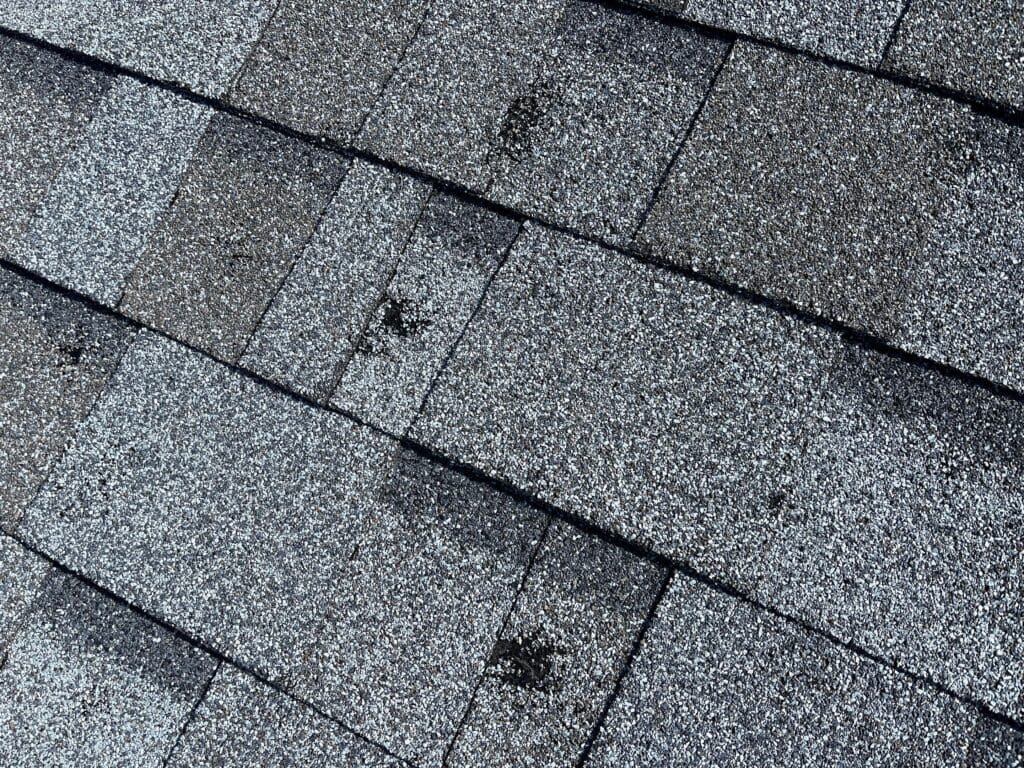
The other thing to know: hail damage on an asphalt roof is almost always random and scattered. Normal aging wears a roof down relatively evenly. Meanwhile, hail hits are concentrated on the exposed slopes of the roof, and damage is often heavier on whichever side faced the wind. If you see a uniform pattern of surface wear, that’s likely age. If you see irregular dark spots clustered in areas that were exposed to the storm, that’s a different conversation.
On impact-resistant shingles: Class 4 asphalt shingles, rated under the UL 2218 standard, are built with polymer-modified asphalt that flexes on impact instead of cracking and creating hail damage to your roof. Aurora currently requires them for re-roofing projects, and a number of other Denver-area municipalities are moving in the same direction. Beyond code, they’re worth considering due to the insurance benefits. Some insurers offer premium discounts if you opt for a verified Class 4 installation.
How To Tell If A Wood Shingle Or Shake Roof Has Hail Damage
While cedar shakes suit the mountain aesthetic, they also happen to be among the roof materials most vulnerable to hail damage. Wood doesn’t dent; it splits. A direct hit from hail forces the grain apart, and unlike the slow cracking you see from years of freeze-thaw cycling, hail splits are sharp and fresh. The interior wood will be bright orange-brown rather than grey, the edges clean rather than weathered.
Beyond the splits, look for spatter marks to identify roof damage: places where hail grazed the surface and scraped away the weathered outer layer, leaving a lighter-colored scuff. And after a significant storm, check whether any individual shakes have been knocked completely free. Shakes that were already slightly lifted by prior wear don’t take much to dislodge entirely.
The split wood itself creates new problems beyond the immediate roof damage. Gaps in the surface trap debris and hold moisture, which accelerates rot, a real concern in the foothills climate of Colorado, where you can get afternoon thunderstorms followed by overnight freezes.
What Does Hail Damage Look Like On A Metal Roof?
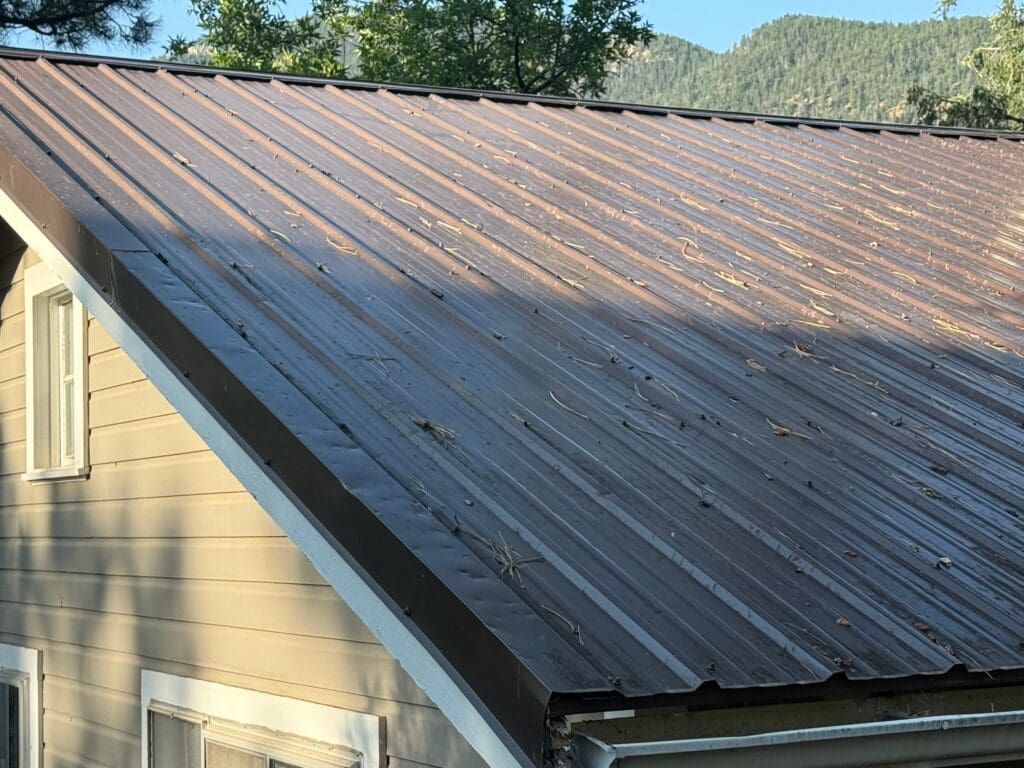
Metal roofing has grown in popularity across the foothills, and for good reason. It handles Colorado weather better than most roofing materials, and hail damage to a metal roof rarely causes the water infiltration problems you see with shingles or tile.
Most metal roofing products carry a Class 4 impact resistance rating (the highest rating under UL 2218). In practical terms: hail will dent your roof, but it very rarely damages by punching through or creating a water infiltration problem the way it does on shingles or tile.
The damage you’ll see on a metal roof after hail looks a lot like what you see on a car hood: circular depressions scattered across the panels, sometimes with chipped or scratched coating at the center of the impact. Larger hail stones leave more pronounced dents and damage on your roof; smaller ones may leave marks you’d only notice in raking light.
The more important thing to check on a metal roof isn’t the cosmetic denting; it’s whether any impacts near seams or fasteners have caused damage to the seal. That kind of hail damage is hard to spot visually and is one of the main reasons a professional inspection matters, even on a roof that looks fine at first glance.
One practical note: cosmetic denting and damage alone on a metal roof often don’t meet the threshold for a covered hail insurance claim. Some policies explicitly exclude cosmetic damage, so it’s worth reading your policy language before you file.
What Does Hail Damage Look Like On A Clay Or Concrete Tile Roof?
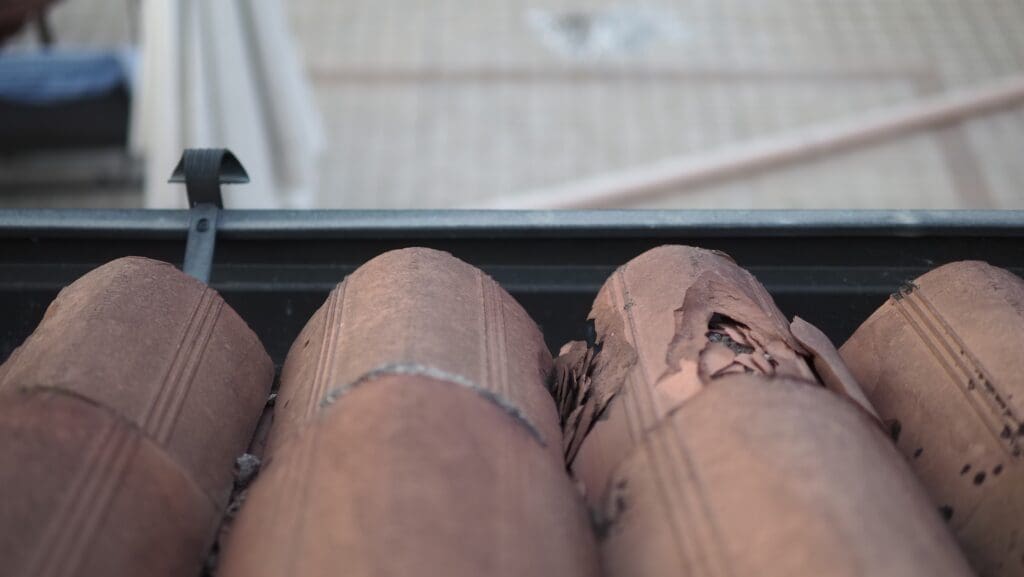
Clay and concrete tile looks and feels solid, and it handles a lot of weather well. The problem is that both materials are brittle, which makes hail damage to tile roofs look very different from what you see on shingles.
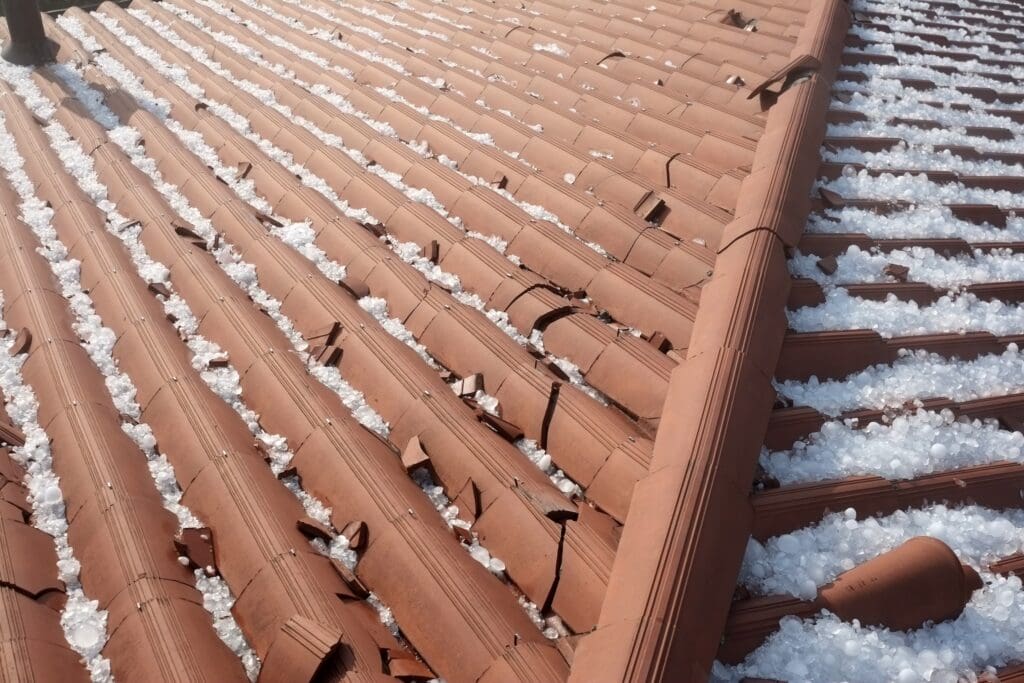
A large hailstone hits a tile, and it doesn’t dent. It cracks, chips, or, in some cases, shatters. After a significant storm, it’s not unusual to find broken tile fragments in the gutters or on the ground around the perimeter of the house.
The more insidious hail damage is the hairline crack that forms at the point of impact on a tile roof. The tile stays in place, looks intact from below, and allows water to work under it every time it rains. By the time that becomes a visible interior problem, there’s usually been months of slow moisture intrusion.
One thing worth knowing about tile: don’t get up on a tile roof to look at the hail damage yourself. Foot traffic cracks tile, including tiles that survived the storm intact. If you suspect tile damage, the inspection needs to be done by someone who knows how to navigate a tile roof without causing more issues.
What Does Hail Damage Look Like On A Slate Roof?
Natural slate is dense, durable, and genuinely one of the better roofing materials for hail resistance if you’re in hail country. It resists most storms well. But large, dense hailstones can still chip the edges and corners, crack tiles across the face, or dislodge them from their fastening, particularly on older roofs where the fasteners have corroded.
Face cracks in slate are sometimes only visible from certain angles in certain light. They can allow water under the surface without any obvious exterior sign of the damage. And a dislodged slate, even one or two of them, creates an immediate opening in the roof covering.
The good news for slate roof owners: like tile, individual slates that have experienced hail damage can usually be replaced without touching the rest of the roof. Given that a well-maintained slate roof can last 75 to 150 years, that’s often the right call after hail damage.
What Does Hail Damage Look Like to a Low-Slope (Flat) Roof?
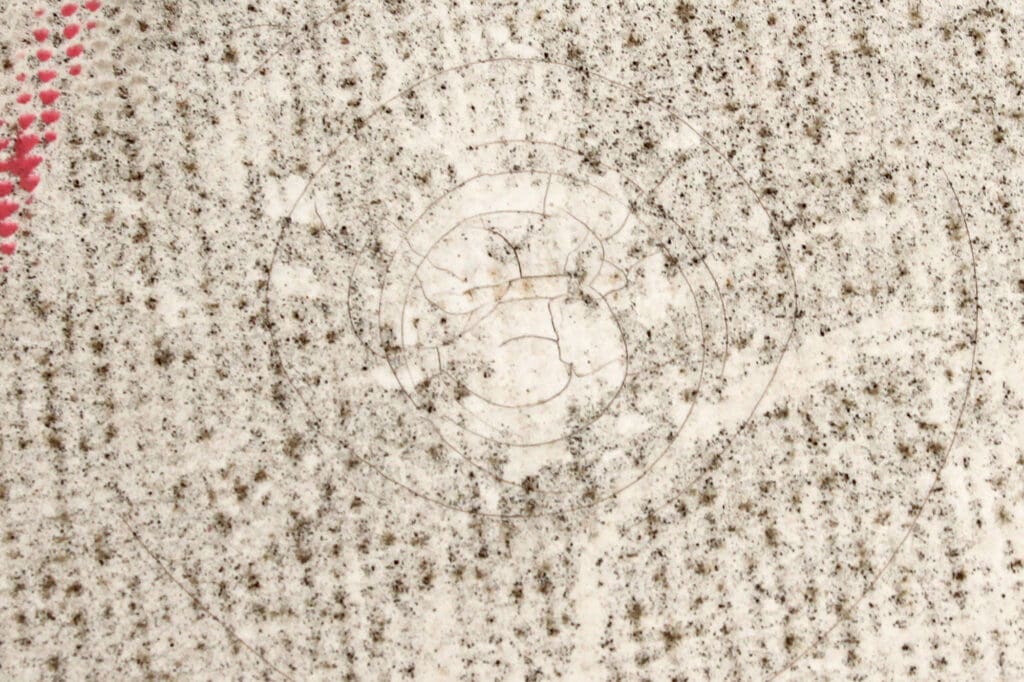
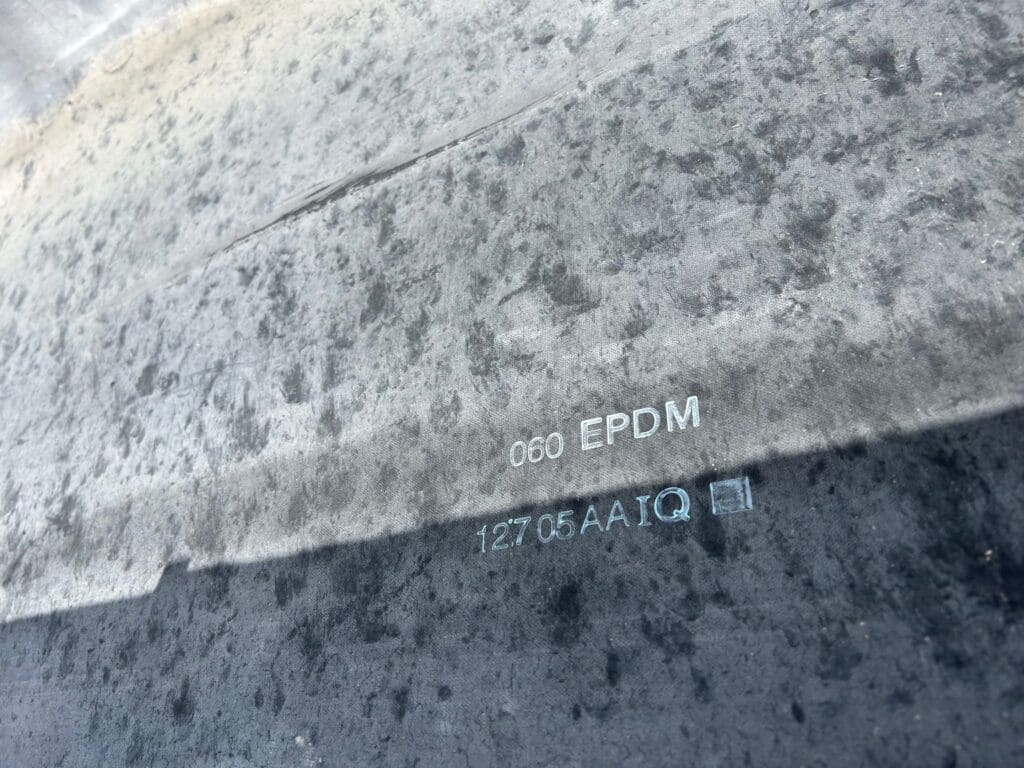
Flat roofs covered with EPDM rubber, TPO membrane, or modified bitumen take hail hits differently than a pitched roof, and the damage can be easier to miss. Instead of cracked shingles or dented metal, you’re looking for dimpling in the membrane surface: circular depressions where the hailstone hit but didn’t punch through. On a newer, thicker membrane, those dimples may cause no immediate problem. On an older, UV-degraded membrane, that same impact can create a stress fracture or a small breach that isn’t obvious until water shows up inside.
On a modified bitumen roof, watch for granule loss the same way you would on asphalt shingles that have hail damage. Bare, shiny patches where the granule surfacing has been stripped away leave the membrane exposed and vulnerable.
There’s a subtler form of hail damage that shows up specifically on adhered single-ply roof membranes (TPO, EPDM, and PVC) and gets missed far more often than it should. Single-ply membranes sometimes don’t puncture or tear from hail impact at all. The surface looks intact. But inspection reveals that the impacts have compromised the adhesion between the membrane and the underlying cover board or insulation beneath it. That localized de-bonding is functional damage even without a visible breach, because it changes how the roof system performs and accelerates future deterioration at those points. It’s the kind of thing that only becomes obvious during a professional roof damage inspection, not a surface-level look for hail impact.
This gets at a useful working definition of what hail damage to a roofing system actually means in a technical sense: a roof covering has been damaged by hail when the impact has either compromised its water-shedding or waterproofing ability (through fractures, tears, or punctures of the membrane or reinforcements), or reduced the expected service life of the material in the affected area (through fractures, chipping, spalling of a coating or surfacing, or compromised adhesion). That second category, reduced service life without an immediate leak, is where a lot of hail damage goes unrecognized and unclaimed.
Seams and flashing are the other areas to pay attention to when determining how to tell if your roof has hail damage. Hail combined with wind can cause these to lift or pull apart slightly. It’s not always visible from below, but enough to create a slow leak pathway. Because low-slope roofs are more likely to have issues with ponding water, even a small opening in the membrane can cause disproportionate interior damage.
Signs To Look For From The Ground
While getting on your roof to look for hail damage is going to be the most accurate way to assess, you can still gather some meaningful information from the ground. A careful walk around your property after a storm can tell you quite a bit, and some of what you find at eye level is exactly the kind of corroborating evidence that supports an insurance claim.
Start with the gutters. Run your hand along the face and feel for dents. Then look inside. If you see dark, sand-like particles settled in the gutter trough or washing out at the base of the downspouts, those are likely shingle granules. Finding a meaningful quantity of them after a storm is one of the clearest early indicators of hail damage to your roof.
Check the soft metal components you can see from the driveway. Pipe boots, exhaust caps, ridge cap metal, and fascia all dent easily, and they dent from the same hail that hit your shingles. If the vent caps are pockmarked, the roof took the same event. This is also evidence that your adjuster will look at when they’re determining if your roof has hail damage.
You’ll want to peek at your home’s siding and window screens as well to assess for damage. Dents in aluminum or vinyl siding, torn screens, and chipped caulking around window trim are all consistent with hail impact. A house whose siding shows clear hits was struck with enough force to potentially affect the roof.
The AC condenser is worth checking, too. The aluminum fins on the outdoor unit are thin and exposed, and they show hail damage even when other surfaces don’t. If the fins are dented or pushed inward, that tells you something about hail size and intensity, and could hint at potential roof damage.
Walk the perimeter and look at the ground. After a significant storm with tile or slate on the roof, you’ll sometimes find fragments in the flower beds, along the foundation, or in the gutters.
Roofing pro tip: Before you clean anything up, photograph what you find. Put a quarter next to each impact mark you photograph to provide a sense of scale. Aim to take photos at different times of the day. Late afternoon light does a good job of casting shadows that reveal dents and depressions that wash out in flat midday sun.
How To Tell If It’s Hail Damage Or Just Normal Roof Aging
One thing that trips up a lot of homeowners, and complicates a fair number of hail damage insurance claims, is confusing normal roof wear with actual storm damage. The two can look similar on the surface, and adjusters are trained to tell them apart. It helps to know the difference yourself before anyone gets on the roof.
Normal aging on an asphalt shingle roof tends to be uniform. The whole surface weathers together. Granule loss from age happens evenly across the field, the shingle surface becomes brittle and curling develops gradually, and any cracking follows the natural pattern of thermal expansion over many seasons. If your shingles are 18 years old and look rough all over, that’s age, rather than hail damage to your roof.
Hail damage to your roof is random and directional. The impacts are scattered, not uniform, and they’re concentrated on the slopes that faced the storm. Fresh hail hits on an asphalt roof look different from age-worn surfaces: the impact point is darker, slightly indented, and often soft to the touch. The surrounding shingle looks fine. That contrast, a localized soft spot on an otherwise intact shingle, is characteristic of hail and not consistent with normal deterioration.
On a roof with wood shakes, telling hail damage apart from age is more clear-cut. Fresh hail splits show bright interior wood with sharp, clean edges. Age cracks and moisture splits have weathered grey edges and rounded fracture points, and they tend to follow the grain over a longer distance. A sharp, short split with exposed orange-brown interior almost always points to impact.
A note on blistering: Asphalt shingles can blister from trapped moisture or manufacturing issues, and the resulting surface bubbles are sometimes mistaken for hail impact and damage to your roof. Blisters are raised rather than depressed, and they typically occur on the south-facing slope where heat is most intense. Hail impacts are depressions, not raised spots. If you’re pressing on a shingle and it feels like a raised blister rather than a sunken bruise, that’s not a hail hit.
The reason this matters beyond curiosity: insurance adjusters will note pre-existing wear and separate it from storm damage when calculating what they owe. Going into an inspection with a clear sense of what your roof looked like before the hail storm, whether you have photos, prior inspection reports, or just a general knowledge of the roof’s age, helps you have a more informed conversation about the damage.
What Insurance Adjusters Actually Look For When Doing Their Assessment
If you’re going to file a claim for roof hail damage, it helps to understand the process from the adjuster’s side before they show up. Knowing what they’re measuring and what they need to see means you can walk the property more effectively and avoid being caught off guard by the outcome.
Adjusters don’t assess a roof as a whole. They work in sections. The standard method is to mark off 10-by-10-foot test squares on each slope and count the functional hail hits within each square. The specific hit threshold that triggers a recommendation for replacement varies by insurance company, but 7 to 10 confirmed hits per square is a commonly cited benchmark. Squares get placed on the roof slopes that look most heavily affected by hail, not in areas sheltered from damage by overhangs or trees.
The distinction between functional and cosmetic hail damage is the one that determines whether your roof claim gets approved. Functional damage is anything that compromises the roof’s ability to keep water out: a cracked shingle, a punctured membrane, a fractured tile. Cosmetic damage is surface-level change that doesn’t affect performance, like a dent in a standing seam panel that remains completely watertight. Many policies exclude purely cosmetic damage, particularly on metal roofs. Reading your specific policy language before the adjuster visit is worth a few minutes of your time.
Adjusters also verify the weather behind every roof hail damage claim. They cross-reference NOAA and National Weather Service data to confirm that a qualifying hail event actually occurred at your address on the date you filed for. If your claim date and the weather records don’t line up, the claim will face scrutiny. Checking a resource like the NOAA Storm Events Database yourself isn’t a bad idea.
Roof age and pre-storm condition factor into the payout structure in ways homeowners don’t always anticipate. If you have an older roof, you may receive an Actual Cash Value payout (replacement cost minus depreciation), as opposed to a full Replacement Cost Value. A roof that was clearly at the end of its service life before the storm gets evaluated differently from a five-year-old one. Knowing whether your policy is ACV or RCV before you file can change your financial expectations.
Other factors adjusters weigh when trying to tell if your roof was impacted: the pattern and distribution of hail damage (impacts are random and scattered; concentrated damage in one spot raises questions), and corroborating evidence from other surfaces like gutters, vents, and AC units. If your gutters are dented and your AC fins are pocked, that supports the claim that a qualifying storm hit the property.
If you’re working with a roofing contractor you trust, having them present during the adjuster visit is worth arranging. They can walk the property together, point out specific hail damage on your roof, and provide professional documentation that can serve as a counterweight if the adjuster’s assessment seems to miss things.
One thing to do before any of this: pull out your homeowner’s insurance policy and read it. Some carriers require you to contact them before a third-party contractor assesses or documents any hail damage to the roof. Getting this right protects your claim.
What Makes Some Roofs Hold Up To Hail Damage Better Than Others
Two houses on the same street can come out of the same hail storm with completely different levels of roof damage. A lot of that comes down to factors you can actually control.
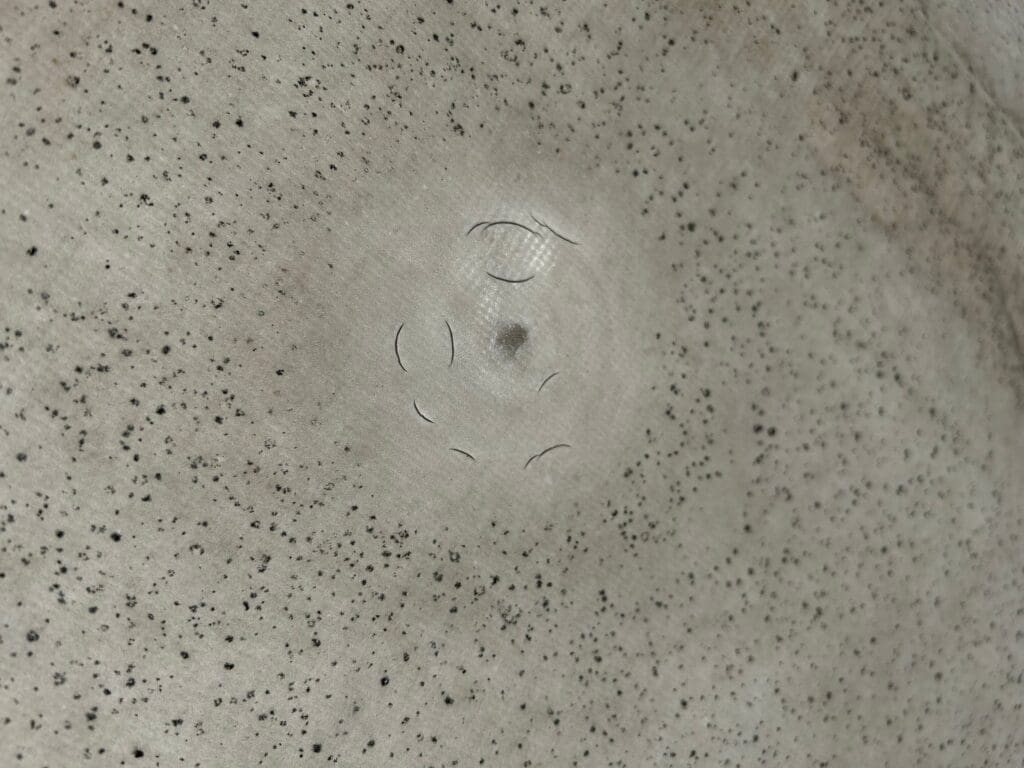
Hail size is obviously a major variable. Pea-sized stones (around three-quarters of an inch) can dislodge granules and ding gutters, but they generally don’t cause serious structural damage. Quarter-sized hail (one inch) starts bruising underlayment and causing real shingle damage on your roof. Golf-ball sized (one and three-quarter inches) causes significant damage to most materials. At two and a half inches or larger, the question isn’t typically whether there’s damage, but where.
Beyond size, the density and shape of the stones affect how hail damage presents on the roof. An irregular, jagged hailstone cuts and scrapes where a smoother one of the same diameter might only dent. Wind speed can change the impact angle and force dramatically. Sixty mph wind-driven hail does more damage to a given slope than the same stone falling straight down.
On the controllable side:
- The material you’re roofing with
- Whether your roofing material carries a Class 4 impact resistance rating
- How old the current roof is going into a storm
- The pitch and shape of the roof
- The quality of the underlayment system beneath the surface layer.
Steeper pitches deflect hail at a glancing angle and take less direct force. Hip roofs (four sloping sides) generally fare better than simpler gable designs. And good underlayment buys you some protection when the outer surface layer gets breached.
Roof age matters more than most homeowners realize going into hail season. A newer roof with flexible, intact materials absorbs impact in ways that a fifteen-year-old roof with brittle, UV-degraded shingles won’t. The same one-inch hail storm that leaves a relatively new roof with minor bruising can crack and damage an older roof across multiple slopes.
How Hail Damage Quietly Shortens The Life Of Your Roof
This is the part that catches people off guard: hail damage usually doesn’t announce itself with an immediate leak in your roof. What it does instead is create a set of vulnerabilities that get progressively worse with every season that passes without being addressed.
Granule loss accelerates the whole timeline of roof degradation. Once the granule layer on an asphalt shingle is knocked away, the underlying asphalt mat is exposed to that harsh, direct Colorado sun. UV breaks it down. The material dries out and starts to crack. What was going to be a 25-year roof is now looking at 12 to 15 years, and that estimate keeps shrinking with each additional storm season and hail damage incident.
The bruising underneath the roof surface is the other form of hail damage that compounds silently. Impact damage weakens the fiberglass mat inside the shingle without creating any visible sign from the outside. The shingle looks intact. Nothing is leaking. But every Colorado winter runs freeze-thaw cycles through those micro-fractures, widening them gradually. Eventually, they open into cracks. Water gets in. The decking gets wet. Wet decking grows mold, and mold spreads into attic insulation and framing, usually long before any homeowner has any idea it’s happening.
By the time a water stain shows up on a ceiling, the damage pathway typically runs through multiple roof layers. You’re not just replacing a few shingles at that point. The repair pathway often includes decking sections, insulation, and sometimes framing, and the total can push past $20,000 on what started as modest roof hail damage. Insurance companies sometimes decline to cover it at that stage, categorizing it as deferred maintenance rather than a storm event.
A standard asphalt roof is rated for 20 to 25 years. A severe hail storm that leaves roof hail damage unaddressed can cut that down to 10 to 12.
What Level Of Impact Warrants Repair Or Replacement?
This is the practical question for any homeowner trying to assess hail damage on a roof along the Front Range, where hail is not an unusual event but a recurring seasonal one. You don’t want to replace a roof that didn’t need it, and you also don’t want to miss damage that’s quietly compounding.
Repair tends to be the right answer when the affected area is contained:
- When a handful of shingles on one section are impacted.
- When underlayment is dry and intact underneath
- For a roof under 10 to 12 years old, with no other signs of age-related deterioration.
- When there’s no moisture in the attic, and no water stains inside.
Replacement is typically what’s warranted when:
- The adjuster or contractor finds 7 to 10 or more functional hits per test square across multiple slopes
- Granule loss is widespread rather than patchy
- The roof is 15 or more years old, and the hail damage has tipped an already-aging system past the point where partial repair makes economic sense
- Tthe decking has been compromised by moisture intrusion.
Roofing pro tip: if your roof already has two layers of shingles on it, most building codes in Colorado require a full tear-off before adding another layer, which makes significant hail damage repair functionally equivalent to a full replacement anyway.
The insurance coverage distinction that trips people up most often is functional versus cosmetic damage. Functional damage, meaning anything that compromises the roof’s ability to keep water out, is what policies typically cover. Surface-level cosmetic changes that don’t affect performance, like denting on a metal roof that remains completely watertight, may not be covered. Some policies exclude cosmetic damage explicitly. That’s worth understanding before the adjuster walks your roof to identify hail damage.
Practically speaking, for Front Range and foothills homeowners assessing roof hail damage after storm season: if you’re regularly finding granules in your downspouts, if you’re seeing soft spots on shingles, or if water stains are appearing inside after heavy rain, those are signals worth a professional opinion, regardless of whether any individual storm looked severe from the driveway.
Is Getting An Inspection Worth Your Time?
Even when a roof looks fine from the ground, a hail storm that left dents on the gutters and damage on the siding likely reached the roof, too. That’s an important point worth repeating: a roof can look completely undamaged from the driveway and still have serious, noticeable damage when viewed from above.
The real question after any significant hail event isn’t whether something happened up there. It’s whether what happened is going to compound into a problem you’d rather catch now than in two years.
Some of what matters most after a storm is only findable on the roof. Bruising beneath asphalt shingles isn’t visible from the ground. It takes someone pressing on individual shingles, counting impacts within test squares, and understanding what they’re measuring to determine whether functional damage is actually present. A written report of hail damage from a licensed roof contractor documents the findings in a form that carries weight with insurance companies. It’s the difference between a claim supported by professional documentation and a claim supported by your own photos from the driveway.
Timing matters more than most people realize when it comes to hail damage roof claims. Insurance policies have reporting windows, and damage documented promptly is far easier to connect to a specific storm. Damage found two years later is much harder to tie to a cause, and carriers will sometimes reclassify it as a maintenance issue rather than a covered storm event.
Signs that point toward getting a professional assessment of roof hail damage:
- Confirmed hail in your area
- Dented gutters or AC unit fins
- Siding damage
- Granules collecting at downspout bases
- Any new water staining inside the house or in the attic
Before you call a roofing contractor, take a few minutes to pull out your homeowner’s insurance policy to see how they address hail damage. Some providers require you to contact them before a third-party contractor is involved in documenting damage. Getting the order right from the start protects your claim.
Once you’ve confirmed you’re clear to proceed, getting a professional inspection scheduled is the most useful thing you can do for a roof that may have taken a hit.
Table Mountain Roofing offers professional hail damage inspections for homeowners across the Denver metro and the foothills communities. Our team knows what hail damage looks like on a roof: the obvious kind and the kind that doesn’t show itself until it’s become a bigger problem.